
Flies
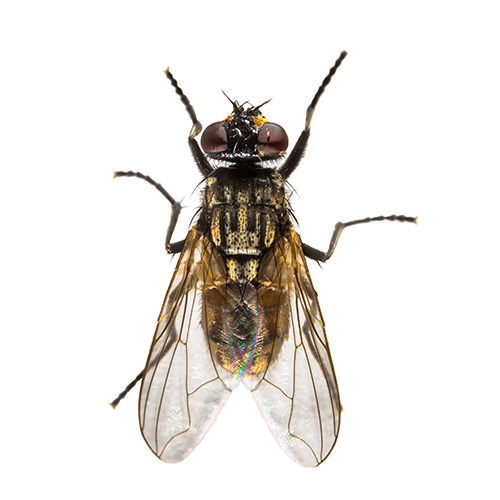
FLIES
(Musa Domestica)
Description:
There are many types of flies in Southern California. Flies
have two pairs of wings, ranging from black-green to shiny
blue. They are generally associated with filth, garbage, and
decaying matter. The common housefly is the most often seen in
domestic and commercial environments. Adults are gray to
grayish-black, are about 1/4 of an inch long and their clear
wings have a distinctive vein pattern.
Biology:
All flies are associated with unsanitary conditions and can be
disease carriers. When feeding, flies regurgitate some of
their stomach contents onto their food, then suck it back into
their stomach. While walking and feeding on garbage, fecal
material, and food, flies transfer disease organisms from both
inside and outside their bodies. Flies are associated with
more than a dozen different diseases. An adult fly can lay 500
eggs in 4 days. In warm weather, a fly's life cycle from egg
to adult is approximately 8 to 12 days.
Did You Know?
If a single pair of breeding flies began reproducing in April, and all their offspring lived and reproduced at the same rate, it would result in 191,010,000,000,000,000,000 (191 quintillion, 10 quadrillion) flies by August. If you put them end to end in a line they would wrap around the earth 2 billion times!
Impact:
Predators, parasites, and several other factors drastically
reduce fly populations. Still, in uncontrolled conditions,
there can be thousands of flies. Flies suggest unsanitary
conditions, promoting pathogens, diseases, contamination, and
odors. For that reason, fly infestations come under Health
Department guidelines. The economic impact of uncontrolled fly
infestations on commercial, industrial, or office property can
be significant and needs to be addressed with appropriate
controls.
Solutions:
Our professionals provide a meticulous inspection regimen,
sanitation advice, follow-ups, baits, and appropriate
insecticides. An effective pest control program requires
mutual effort from owners, managers, and a professional pest
management service.
Additional Links:
http://www.ipm.ucdavis.edu/PMG/PESTNOTES/pn7457.html